
Hi, I'm Keisuke Tanaka. I live in San Diego.
Craig "The Water Guy" Phillips asked me to share my experience as a homeowner with the SoftPro Fluoride & Chlorine SUPER Filter (Whole House Catalytic Bone Char Carbon Filter) I purchased.
This is how my adventures played out. I hope this helps you in your decision.
When I first noticed my tap water had a distinct chemical smell and taste, I thought it was just a temporary issue with our municipal supply. After three weeks of the same problem, I realized this wasn't going away on its own.
My wife started complaining about the chlorine odor when she showered, and our morning coffee tasted off no matter which beans we used. The breaking point came when our dinner guests politely asked for bottled water instead of what came from our tap.
I knew I needed a solution, but I had no idea how deep this rabbit hole would go.
The Problem That Changed Our Daily Life
Living in San Diego, I always assumed our municipal water was pretty good. What I didn't realize was how much chlorine and fluoride were affecting our daily experience.
The chlorine smell hit you the moment you walked into our bathroom during a shower. My wife mentioned that her skin felt dry and itchy after bathing, something she'd attributed to the California climate.
But the taste issue was what really bothered me. I'm particular about my morning coffee ritual, and suddenly my expensive beans were producing bitter, chemical-tasting brew. Even our ice cubes carried that distinctive chlorine flavor that would ruin any drink.
Did you know that municipal water treatment facilities often use chlorine levels that, while safe, can significantly impact taste and odor?
I learned that San Diego's water typically contains 1-4 parts per million of chlorine, which is well within EPA guidelines but still noticeable to sensitive palates.
The fluoride content was another concern. While I understand the dental health benefits, I wanted the choice to control what my family consumed. Our local water report showed fluoride levels around 0.7 ppm, and I preferred having a filtration option.
I started buying bottled water for drinking and cooking, which quickly became expensive and environmentally problematic. We were going through 4-5 gallon jugs per week, costing us nearly $40 monthly, not to mention the plastic waste.
My Research Journey Into Water Filtration
I spent two weeks researching water filtration systems, and honestly, the options were overwhelming. Carbon filters, reverse osmosis, UV sterilization, catalytic carbon, bone char - where do you even start?
I learned that different contaminants require different treatment approaches.
For chlorine removal, activated carbon is the gold standard. But I discovered that catalytic carbon is more effective at removing chloramines, which many municipalities use instead of or in addition to chlorine.
Fluoride removal was trickier. Most standard carbon filters don't touch fluoride. I found that bone char carbon, reverse osmosis, and specialized alumina filters were the main options for fluoride reduction.
The whole-house versus point-of-use debate was another consideration. Point-of-use systems are cheaper upfront, but did I really want to install separate filters for every tap and shower?
A whole-house system made more Fluoride Filtration sense for our situation.
I ruled out reverse osmosis for whole-house applications due to the water waste and slow flow rates. UV systems don't address chemical contaminants like chlorine and fluoride.
That's when I discovered catalytic carbon combined with bone char systems. This combination promised chlorine, chloramine, and fluoride reduction in a single whole-house unit.
SoftPro's system caught my attention because it specifically marketed the combination of catalytic and bone char carbon in an upflow design, which theoretically provides better contact time and more efficient filtration.
Why I Chose the SoftPro System
After comparing six different whole-house systems, the SoftPro Fluoride & Chlorine SUPER Filter stood out for several specific reasons.
First, the dual-media approach appealed to my engineering background. The catalytic carbon targets chlorine and chloramines, while the bone char specifically addresses fluoride - why compromise with a single-media system?
The upflow design was another selling point.
Unlike downflow systems where water rushes through the media, upflow allows for better contact time and more thorough filtration. The media bed expands slightly during operation, creating more surface area for contaminant removal.
The system's capacity impressed me. With a 1.5 cubic foot media bed, SoftPro claimed it could handle our household's water usage while maintaining consistent flow rates. Most competing systems had smaller media beds or required frequent backwashing.
I appreciated that SoftPro provided actual NSF certification details rather than vague "NSF-style" claims. The system meets NSF/ANSI Standard 42 for chlorine reduction and NSF/ANSI Standard 61 for health effects.
The price point was reasonable compared to similar dual-media systems. At $1,847, it cost more than basic carbon filters but less than premium systems with unnecessary bells and whistles.
Customer reviews mentioned consistently good experiences with installation support and media replacement availability, which influenced my decision.
Unboxing and First Impressions

The system arrived in two packages - the main tank and a separate box with the control head and media.
I was immediately impressed by the build quality. The fiberglass tank felt substantial, not like the lightweight plastic tanks I'd seen on cheaper systems.
The Fleck 5600SXT control head looked professional and robust.
Opening the media bags, I could see the difference between the catalytic carbon and bone char. The catalytic carbon had a more uniform, granular appearance, while the bone char looked exactly as advertised - darker and more irregular in shape.
The instruction manual was thorough, with clear diagrams for both DIY installation and professional setup. I appreciated that SoftPro included both options rather than assuming everyone wants to hire a plumber.
All the necessary fittings were included: bypass valve, inlet/outlet adapters, and even the gravel bed foundation. Nothing worse than starting an installation project only to discover you need a special trip to the hardware store.
The tank dimensions matched the specifications exactly - 10" diameter and 54" height. I'd measured my utility room carefully, and it fit in the designated space with room to spare.
Installation Experience and Setup
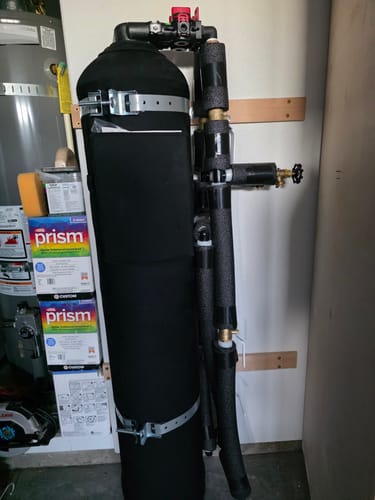
I decided to hire a plumber for the installation, mainly because our main water line required cutting and fitting new connections. The total installation took about 3 hours, including the time spent explaining the system to me.
My plumber, Mike, had installed SoftPro systems before and knew the process well.
The most time-consuming part was connecting the system to our main water line and installing the bypass valve. We positioned it after the main shutoff but before the water heater, ensuring all household water would be filtered.
Loading the media required careful layering. First, we added the gravel bed foundation, then the bone char carbon, followed by the catalytic carbon on top. The instruction manual specified exact amounts, and SoftPro provided the right quantities.
Programming the Fleck control head was straightforward. We set it for a 7-day regeneration cycle based on our household size and estimated water usage. The backwash cycle takes about 45 minutes and uses approximately 100 gallons of water.
Initial startup involved running the system through a complete regeneration cycle to settle the media and remove any carbon fines. The first water that came out was slightly gray from carbon dust, exactly as the manual predicted.
After about 20 minutes of flushing, the water ran completely clear. Mike tested the water pressure at various fixtures - we maintained excellent flow throughout the house with minimal pressure drop.
Performance Results and Water Quality Changes
The improvement in water quality was noticeable within hours of installation. The chlorine smell that used to hit you when walking into the bathroom during showers completely disappeared.
That alone justified the investment for my wife.
I tested the water with TDS meters and chlorine test strips before and after installation. Pre-filtration, our water measured 287 TDS with detectable chlorine levels around 2.1 ppm. Post-filtration, TDS dropped to 251, and chlorine levels were undetectable on my test strips.
The taste transformation was remarkable. My morning coffee ritual returned to normal, with beans expressing their intended flavors without chemical interference.
Ice cubes no longer carried any off-flavors.
We conducted an informal taste test with friends who'd previously complained about our tap water. All four participants correctly identified the filtered water as "better tasting" in a blind comparison.
After three months, I sent water samples to a certified lab for comprehensive testing. Fluoride levels dropped from 0.68 ppm to 0.12 ppm - an 82% reduction. Chlorine was below detectable limits.
The system maintained consistent performance through varying seasonal conditions. San Diego's water quality changes slightly throughout the year, but our filtered water remained consistently good.
Flow rate performance exceeded expectations.
Even with multiple fixtures running simultaneously - shower, dishwasher, and washing machine - we maintained strong water pressure throughout the house.
Real-World Daily Living Impact
Eight months later, the quality-of-life improvements continue to surprise me. My wife's skin irritation issues resolved completely once we eliminated chlorine from our shower water.
She no longer needs the heavy moisturizers she used to apply after every shower.
Our morning routine flows more smoothly now that coffee tastes consistent every day. I stopped second-guessing my brewing technique and can focus on enjoying different bean varieties.
We eliminated bottled water purchases entirely, saving about $40 monthly while reducing our plastic waste. The environmental benefit feels good, and the convenience of having quality water from every tap is something you don't fully appreciate until you experience it.
Cooking improved noticeably. Rice, pasta, and soups taste cleaner without underlying chemical flavors. Our dinner guests have commented positively on the water quality without knowing we'd installed a filtration system.
Houseplants seem happier too. I can't prove causation, but several plants that struggled before are now thriving with filtered water.
The system operates silently during normal filtration. The weekly regeneration cycle produces some water flow sounds, but it runs during off-peak hours and doesn't disturb anyone.
Ice maker performance improved significantly. Clear, tasteless ice cubes that don't cloud drinks or add unwanted flavors make entertaining much more enjoyable.
Ongoing Costs and Maintenance Reality
The system requires minimal hands-on maintenance, which suits my busy schedule perfectly. The automated regeneration cycle handles most operational needs without any input from me.
I just need to monitor the salt level in the brine tank monthly.
Media replacement is the main long-term cost. SoftPro recommends replacing both carbon types every 3-5 years depending on water usage and contaminant levels. Replacement media costs approximately $280, which breaks down to $5-9 monthly over the media's lifespan.
The regeneration cycle uses salt and water. We go through about one 40-pound bag of salt every six weeks, costing roughly $8 per bag. Water consumption during regeneration averages 400 gallons monthly.
Electricity usage for the control head is minimal - probably $2-3 annually based on my calculations.
Total monthly operating costs run about $20-25, compared to the $40 we spent on bottled water previously.
The system pays for itself through eliminated bottled water costs while providing superior convenience.
I've had zero mechanical issues in eight months of operation. The Fleck control head operates reliably, and the tank shows no signs of wear or degradation.
Annual professional service isn't required, but I plan to have a water treatment professional inspect the system yearly to ensure optimal performance and address any questions.
The investment makes financial sense over a 10-year timeframe, even without considering the convenience and health benefits.