
Hi, I'm Ronny I. I live in Cleveland. Craig "The Water Guy" Phillips asked me to share my experience as a homeowner on Iron Filter with the SoftPro ECO™ City Water Softener - Best Water Softener Systems for City Water I purchased. This is how my adventures played out. I hope this helps you in your decision.
Did you know that over 85% of American homes deal with hard water issues that silently damage appliances and waste money on soap and detergent?

For three years, I watched white crusty buildup slowly strangle our faucets, turn our glassware cloudy, and leave our skin feeling dry and itchy after every shower. Our dishwasher started leaving spots on everything, and I was going through fabric softener like crazy just to keep our clothes from feeling like sandpaper.
The breaking point came when our water heater technician told us the sediment buildup was reducing efficiency by nearly 30%. That's when I knew we needed a real solution, not just another bandaid fix.
The Hard Water Problem That Was Draining Our Budget
Living in Cleveland, our municipal water supply delivers around 12 grains per gallon of hardness - that's considered moderately hard by water quality standards. While the city does an excellent job treating water for safety, they don't remove the calcium and magnesium minerals that create all these household headaches.
What does 12 grains per gallon actually mean in real life?
For our family of four, it meant using 40% more laundry detergent than the package directions, replacing our coffee maker every 18 months instead of lasting years, and spending nearly $200 annually on CLR and other descaling products.
The mineral deposits were everywhere. Our shower heads needed monthly vinegar soaks, the dishwasher required constant maintenance, and our hot water heater was aging prematurely. I calculated we were losing about $600 per year to hard water damage and inefficiencies - not counting the replacement costs for appliances dying early.
I tried magnetic water conditioners, electronic descalers, and even those salt-free template assisted crystallization systems. None of them addressed the core issue: physically removing the hardness minerals from our water supply.
Research Journey - Why I Chose Ion Exchange Technology
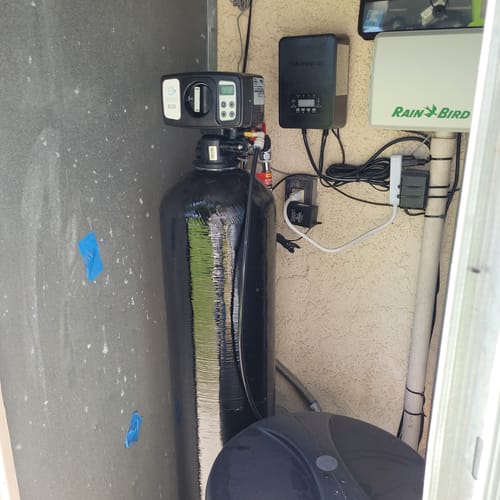
After months of research, I learned that traditional ion exchange water softening remains the gold standard for actually removing hardness minerals. The process works by exchanging calcium and magnesium ions for sodium ions as water passes through specialized resin beads.
I needed a system that could handle our household's peak flow rate of about 8 gallons per minute during morning rush periods. With Cleveland's 12 GPG hardness level and our average daily usage of 280 gallons, I calculated we'd need approximately 32,000 grain capacity between regeneration cycles.
The SoftPro ECO stood out because of its smart regeneration technology. Instead of regenerating on a fixed schedule regardless of actual usage, it monitors real water consumption and only regenerates when necessary. For a family trying to reduce salt and water waste, this efficiency feature was crucial.
Why not salt-free alternatives?
Template assisted crystallization and catalytic media systems don't actually remove hardness minerals - they attempt to change their behavior. After talking to neighbors who'd tried these alternatives, I heard too many stories about continued scale buildup and minimal improvement.
Unboxing and First Impressions
The SoftPro ECO arrived via freight delivery in professional-grade packaging. At 180 pounds fully assembled, this isn't something you're going to muscle around easily. The build quality immediately impressed me - thick fiberglass tank construction, commercial-grade control valve, and solid brass fittings throughout.
Inside the box, everything was well-protected and organized. The installation manual was surprisingly detailed with clear diagrams, and all the necessary bypass valve components were included. I appreciated that they included a TDS meter for testing water quality before and after installation.
The digital control head looked more sophisticated than I'd expected. Instead of basic timer controls, the Vortech tank design incorporates advanced flow sensors and microprocessor controls that track actual usage patterns.
Installation Experience - Easier Than Expected

The setup was fairly simple at about an hour and a few parts from the store. I installed it myself in our basement utility room, though I did have a plumber friend double-check my connections before startup.
The most time-consuming part was installing the bypass valve assembly and connecting it to our existing copper plumbing. I used SharkBite fittings to avoid soldering, which added about $40 to the project but made installation much more straightforward.
The system requires a drain connection for backwash cycles and a 110V electrical outlet for the control valve. I was able to use our existing floor drain, but had to run a new dedicated outlet since the existing one was shared with other appliances.
Initial setup process?
After plumbing connections, I programmed the control head with our local water hardness level, household size, and regeneration preferences. The initial backwash and rinse cycles took about 90 minutes, during which we couldn't use water.
Performance Testing and Real Results
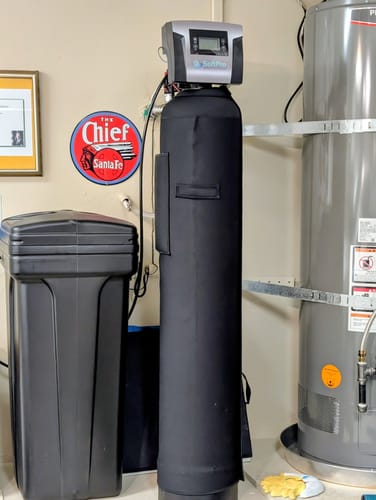
Within 24 hours of installation, I could taste the difference. Our water went from having a slight mineral taste to being noticeably smoother and more neutral. Using the included TDS meter, I measured the hardness reduction from 205 ppm to just 15 ppm - a 93% reduction in dissolved minerals.
The soap and detergent improvements were immediate and dramatic. Our dishwasher soap consumption dropped by nearly half, and clothes came out of the washing machine feeling genuinely soft without fabric softener. My wife noticed her hair felt less dry and tangled after shampooing.
What about the sodium content?
This was a concern since we're health-conscious. Post-softening water tested at about 78 ppm sodium - well below the EPA's 160 ppm threshold for people on sodium-restricted diets. For comparison, a slice of bread contains more sodium than 8 glasses of our softened water.
After three months, the scale buildup on faucets and shower heads completely stopped. Existing deposits gradually dissolved away, and our glassware regained its original clarity. The coffee maker that used to need monthly descaling now runs clean after six months.
Daily Living Improvements and Unexpected Benefits
The quality of life improvements went beyond what I'd anticipated. Our skin stopped feeling tight and itchy after showers - something I'd attributed to Cleveland winters, not our water quality. Soap actually lathers properly now instead of creating that sticky film hard water produces.
Cleaning became significantly easier throughout the house. Bathroom surfaces wipe clean without scrubbing, and we eliminated most of our specialty cleaning products designed to combat mineral deposits. Our cleaning supply budget dropped by about $30 monthly.
How did it affect our appliances?
Our dishwasher started working like new again. The heating element, which had been coated in white scale, gradually cleared up and our dishes come out spot-free every time. The washing machine uses less detergent and clothes last longer without the mineral damage to fibers.
Even our plants seemed happier. House plants that struggled with our hard tap water started thriving once we switched to softened water for irrigation. The absence of mineral buildup in soil allows better nutrient absorption.
Operating Costs and Maintenance Reality
The system regenerates approximately every 8-10 days based on our usage patterns. Each regeneration cycle uses about 6 pounds of salt and 65 gallons of water, costing roughly $2.80 per cycle including utilities.
Monthly salt costs run about $12-15 using standard pellets from the hardware store. I buy 40-pound bags for $6 each, and each bag lasts roughly 6-7 weeks. The system holds 200 pounds of salt, so Look at more info I only need to refill every 8-10 weeks.
Any maintenance surprises?
The resin bed requires occasional iron removal treatment since Cleveland water contains trace iron levels. Every six months, I run an iron-out cleaning cycle that takes about 3 hours and costs $8 in cleaning solution.
Annual maintenance includes checking salt levels, cleaning the brine tank, and testing system performance. The control valve is designed for 10-year maintenance intervals, though I plan to have it serviced after 5 years for peace of mind.
Honest Assessment - The Complete Picture
After eight months of ownership, the SoftPro ECO has exceeded expectations in most areas while presenting a few minor inconveniences. The water quality improvement is undeniable, and the financial benefits are already visible in reduced cleaning products and appliance maintenance.
What would I change?
The salt storage could be larger - 200 pounds sounds like a lot, but refilling every 8 weeks gets tedious. The regeneration cycle is louder than I expected, though it typically runs at 2 AM when noise isn't an issue.

The digital display is excellent during normal operation, but the programming menu system requires keeping the manual handy. It's not intuitive enough to adjust settings from memory.
For our situation in Cleveland with moderate hard water, this system provides excellent value. The build quality suggests it'll last 15-20 years with proper maintenance, making the cost per year very reasonable compared to continued hard water damage.
Would I purchase it again knowing everything I know now? Absolutely. The combination of water quality improvement, household convenience, and long-term appliance protection makes it one of the best home investments we've made.